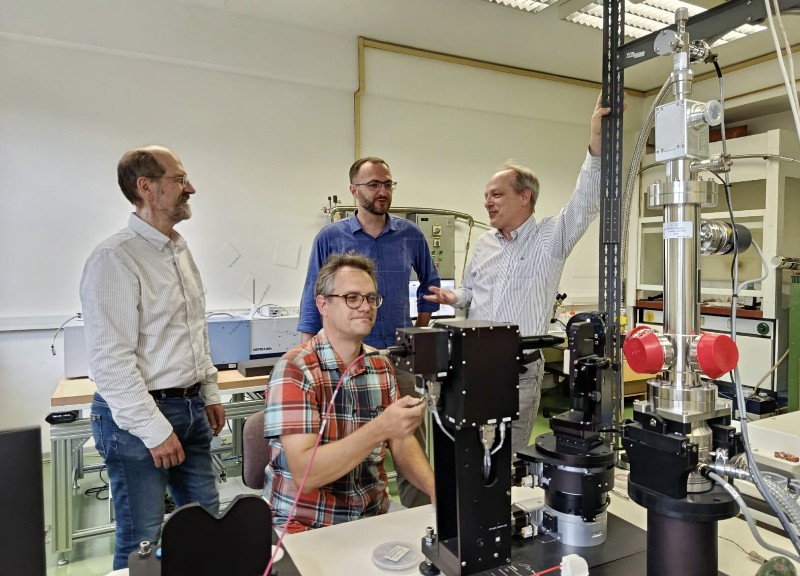
A Unique Discovery From a Croatian Laboratory
An international team of researchers, led by scientists from the Faculty of Science (PMF) in Zagreb, has successfully synthesized a completely new material with exceptional properties. The material, known as murunskite, exists in nature only in trace amounts, but under laboratory conditions, it reveals a magnetic and orbital order previously unseen.
Order From Chaos: A New Scientific Paradigm
According to the research team leader Dr. Neven Barišić, this is the first time that a perfectly synchronized order has emerged from complete structural randomness within a crystal. This opens entirely new possibilities in the field of quantum materials, including the development of superconductors and advanced magnetic systems.
How Murunskite Works
Murunskite contains iron and copper atoms arranged in a random structure. However, when cooled, a phenomenon of magnetic alignment occurs. Dr. Davor Tolj, the lead author of the study and a postdoctoral researcher at Johns Hopkins University, explains that small magnetic clusters gradually merge into larger units that begin to act as a single whole — despite the initial chaos.
Connection With Superconductors
What makes murunskite particularly fascinating is its similarity to existing classes of superconductors — cuprates and pnictides — while combining their properties in a unique way. Scientists believe this type of material could be a key step toward developing superconductors that operate at higher temperatures, which would enable more efficient and stable technologies without the need for extreme cooling.
A New Chapter in Material Science
According to Dr. Barišić, murunskite could represent the “missing link” in understanding how order can emerge from disordered starting conditions. This challenges many existing assumptions in the field of material physics. Moreover, murunskite shows potential resistance to imperfections in manufacturing and use — a significant advantage for future applications.
Collaboration, Support, and Global Recognition
The research was carried out in collaboration with numerous international institutions, including universities and research centers from Austria, France, Switzerland, Singapore, Poland, and the United States. The project received funding from national and European scientific sources, including the Croatian Science Foundation, the Swiss National Science Foundation, the Austrian Science Fund, the CeNIKS project, and the European Research Council.
Published in a Prestigious Journal
The results were published in the respected journal Advanced Functional Materials, confirming this discovery as a significant contribution to global science — proudly led by a Croatian team.