Living with a dog is full of small signs that owners try to interpret every day. Sometimes a dog eats grass and you wonder if something is wrong. Sometimes it keeps licking your face and you are not sure whether it is showing affection, asking for attention, or trying to communicate something. And sometimes chaos simply breaks out at home, during a walk, or in everyday interaction, making it seem as though nothing is working as it should.
The truth is that many dog behaviors are neither strange nor worrying in themselves. The problem begins when we interpret them too quickly, through myths, outdated advice, or human logic that does not match the canine world. That is why it helps to pause, look at the bigger picture, and distinguish between what is normal and what calls for attention, adjustment, or action.
When a dog eats grass, it does not automatically mean something is wrong
One of the most common questions among dog owners is why dogs eat grass. This behavior often worries people because it is frequently linked to nausea, digestive problems, or the idea that the dog is trying to heal itself. While it can sometimes be related to stomach discomfort, in many cases it is not alarming on its own.
Some dogs eat grass out of habit, some out of curiosity, and some because they find the texture or smell interesting. Sometimes it is simply a form of brief environmental exploration, especially in dogs that sniff a lot, observe their surroundings, and react strongly to outside stimuli. Context matters. If a dog eats grass occasionally and otherwise behaves normally, there is usually no reason to panic. But if this behavior is accompanied by vomiting, diarrhea, sudden changes in appetite, lethargy, or repeated patterns, it should be taken more seriously.
That is exactly why it helps to have a clearer picture of what may be behind this kind of behavior, without dramatizing it but also without ignoring the signals. If you would like to explore this topic in more detail, read more here.
When a dog licks your face, it is not always just a sign of affection
Many people see a dog licking as nothing more than an expression of love. And in some cases, licking the face, hands, or staying close to a person’s mouth can indeed be a sign of attachment, a wish for contact, or excitement caused by the presence of someone the dog trusts. But that is not the only possible explanation.
A dog may lick your face to get attention, calm a situation, show submission, or respond to your emotional state. In some dogs, this becomes a learned behavior that grows stronger because it gets a reaction. In others, it appears more often when they are anxious, overstimulated, or insecure. In other words, the same behavior can have very different meanings depending on the dog’s personality and the circumstances in which it appears.
That is why it is not enough to ask only whether your dog licks you, but also when it does it, how often, what state it is in at the time, and what happened immediately before it. Once you start looking at behavior as a whole, your dog becomes much easier to understand. If you want a deeper understanding of what face licking can mean and when it goes beyond what is typical, read our article Why Does a Dog Lick Your Face? What This Behavior Means and When to Be Concerned.
When a dog “creates chaos,” the problem is not always the dog
One of the most frustrating experiences for dog owners is the feeling that their dog is constantly doing something wrong. Pulling, jumping, barking, ignoring recall, destroying things, or seeming as though it is deliberately testing boundaries. In those moments, many people reach for advice that sounds firm and simple but often ends up making the relationship between person and dog even worse.
A dog does not enter into conflict with its owner in the way humans imagine. It reacts to its environment, to stress levels, to consistency, to its own needs, and to the kind of communication it receives. Very often, chaos does not come from having a “stubborn dog,” but from misreading behavior or following advice that ignores the animal’s temperament, age, and emotional state.
Once the owner is given the wrong framework, the dog starts to look like the problem, even though the real issue is a mismatch between expectations and reality. That is why it is worth asking not what is wrong with your dog, but what may be wrong with the advice you have been following. We explored this in the article Is Your Dog Causing Chaos? The Problem May Be the Advice You Were Given.
When to react immediately instead of waiting for it to pass
Not all behaviors are simply meant to be observed. Some require a quick response, especially when they are accompanied by physical symptoms or obvious distress. If a dog suddenly changes its behavior, withdraws, whines, hides, excessively licks one part of its body, limps, loses interest in food, or shows signs of pain, we are no longer talking only about “quirks” or habits.
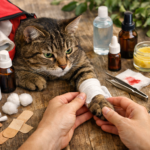
Owners often try to judge whether they should react or whether the situation will resolve on its own. In some cases that is reasonable, but in cases of injury, major behavioral changes, or suspected physical problems, it is better to have basic knowledge and respond calmly but in time. It is especially important to know what you can do right away in the case of minor injuries, and when it is time not to rely on home judgment alone. You can find all of that in our short and very practical guide that gives owners basic orientation in stressful moments.
Dog behavior is not read from a single action, but from a pattern
The biggest mistake in interpreting dogs is that people look for a quick explanation for a single action. The dog ate grass. The dog licked your face. The dog knocked things over in the house. A single scene rarely tells the whole truth. What matters much more is the pattern that repeats, the situations in which the behavior appears, and the dog’s state before and after it happens.
Only when you connect several signals do you begin to see what is normal for your dog and what stands out. That does not mean you need to become an obsessive observer of every little detail. It is enough to stay present and open to the fact that many behaviors are not disobedience, but communication. Your dog is constantly telling you something, just not in human language. That is why it is useful to build your understanding step by step, through the kinds of questions that genuinely arise in everyday life with a dog.