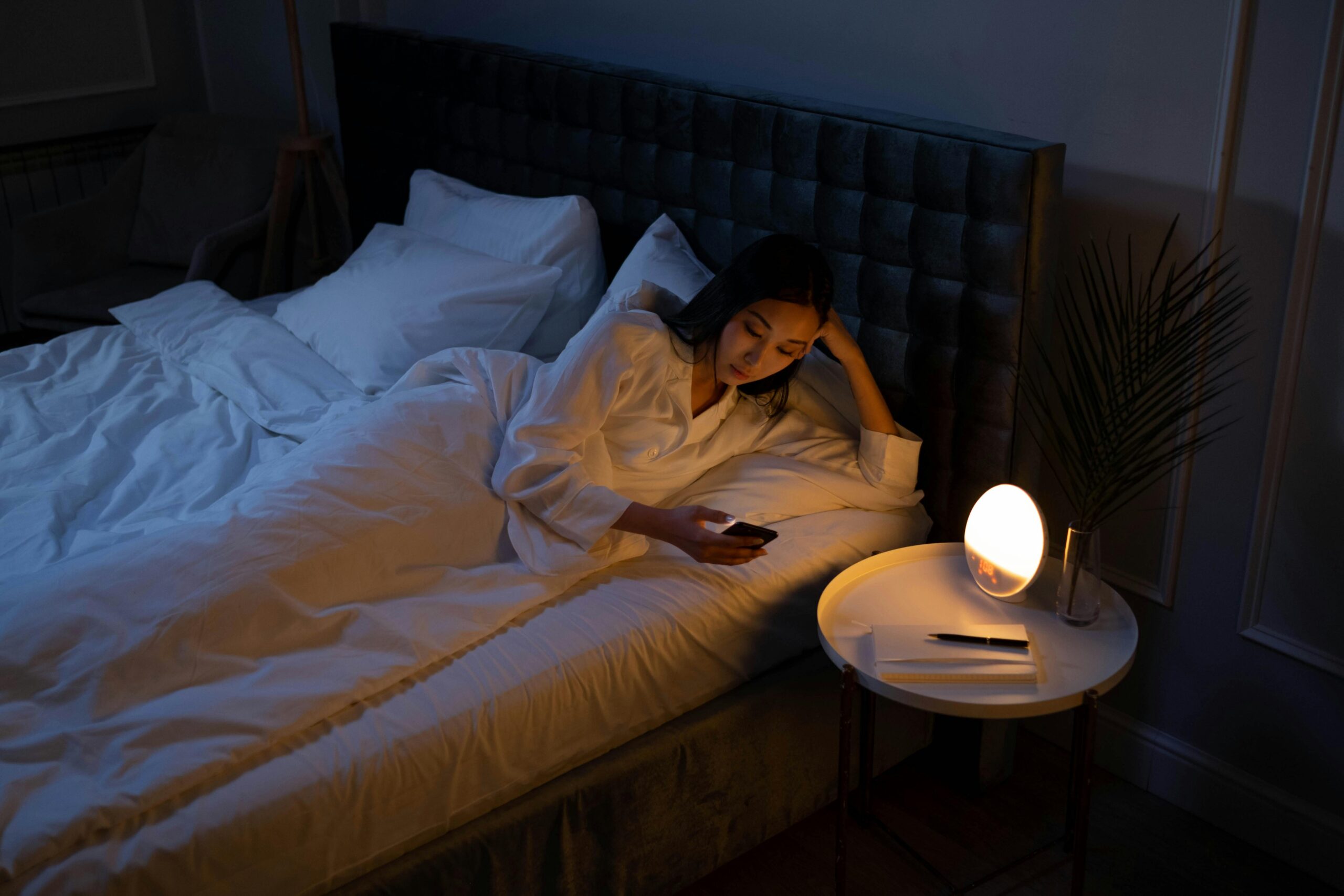
There is a moment most people recognise. The body is tired, the day was long, but the moment you lie down, restlessness. Thoughts won’t stop, the heart won’t slow down, tension lingers without a clear reason. At first it seems illogical. If you’re exhausted, why can’t you simply fall asleep?
Scientists are increasingly looking for answers not in the mind, but in the nervous system itself.
When the Body Doesn’t Recognise That It’s Safe
In everyday language, stress is treated as a mental state. From a neuroscience perspective, it is above all a physiological response involving hormonal, cardiovascular and neurological mechanisms.
The central role belongs to the autonomic nervous system, which regulates bodily functions outside conscious control: heart rate, breathing, digestion, alertness. It operates in two primary modes. The sympathetic system activates in situations the body perceives as demanding or dangerous. It accelerates heart rate, raises cortisol and adrenaline levels, and prepares the body for action. The parasympathetic system takes over when the body determines it is safe, slowing physiological processes and enabling recovery.
The problem arises when the sympathetic system remains active after the stressful situation has passed. This is not a conscious decision, nor a sign of weakness. Because the nervous system learns from experience, prolonged exposure to stress keeps it in a state of readiness that it begins to treat as normal. Switching into parasympathetic mode then becomes difficult, even when the body is objectively safe and tired.
This phenomenon is explored in the polyvagal theory of neurologist Stephen Porges, which describes how the nervous system continuously scans the environment and internal signals, making safety assessments beyond the reach of conscious thought. According to this theory, the sense of safety is not a conclusion of the mind. It is a physiological state the body either has or has not reached.
Modern Stress Doesn’t Look Like It Used To
The classic evolutionary picture of stress is brief: a threat appears, the body responds, the threat passes, the body recovers. That cycle has a clear beginning and end.
Modern stress rarely works that way. There is no single tiger to run from. Instead, there is a constant low-level pressure that never lets up: deadlines, unread messages, financial uncertainty, information noise, unclear obligations, expectations that keep shifting. None of it is large enough to trigger an acute response, but together it holds the nervous system in a state of mild, chronic activation.
Research shows that chronic low-intensity stress can be physiologically more demanding than short acute episodes, precisely because the body has no clear point at which it can “know” it is over. Recovery doesn’t happen because the signal for recovery never arrives.
This is compounded by the fact that modern boundaries between work and rest have blurred. The body struggles to enter a state of relaxation while the mind remains available and on standby. Evening officially begins, but for many people, physiologically, it is still the peak of the working day.
Why Standard Advice Doesn’t Work for Everyone
Meditation, breathing exercises, less screen time, a consistent sleep routine. For some people these methods have a strong effect. For others they don’t, regardless of how disciplined those people are.
The reason is that most of these methods assume the mind is already calm enough for the body to follow. When the system is overloaded, that first step may be precisely what isn’t working.
This is why there is growing interest in the reverse approach: starting with the body, not the mind.
Regulation Instead of Control
In recent years, research interest in nervous system regulation has been growing. The focus is shifting away from trying to control thoughts and toward creating conditions in which the body can calm itself, through movement, touch or breathing rhythm.
One of the newer approaches in this direction was developed by Apollo Neuro. Their wearable device uses gentle vibrations to send the body a physical signal resembling a state of safety, not through cognition, but through sensation. The approach is grounded in autonomic nervous system research and has been tested in several clinical studies.
The device does not replace existing methods. It may be useful for those who feel they know what they should be doing, but cannot put it into practice.
Where This Approach Makes Sense
In the evening, when the body is tired but tense. During work requiring sustained concentration. In moments of heightened stress. As a complement to routines you already have.
More information about how the device works and what options are available can be found here.
For Samo Dobre Vijesti readers, the promotional code SAMODOBREVIJESTI is currently active and reduces the price of the device.
A Broader Shift
What is perhaps more important than the device itself is a change in perspective. There is less and less emphasis on needing to control our state, and more on understanding how the body functions and how to support it.
The question is no longer how to force yourself to relax. It is how to create the conditions in which relaxation becomes a natural response.