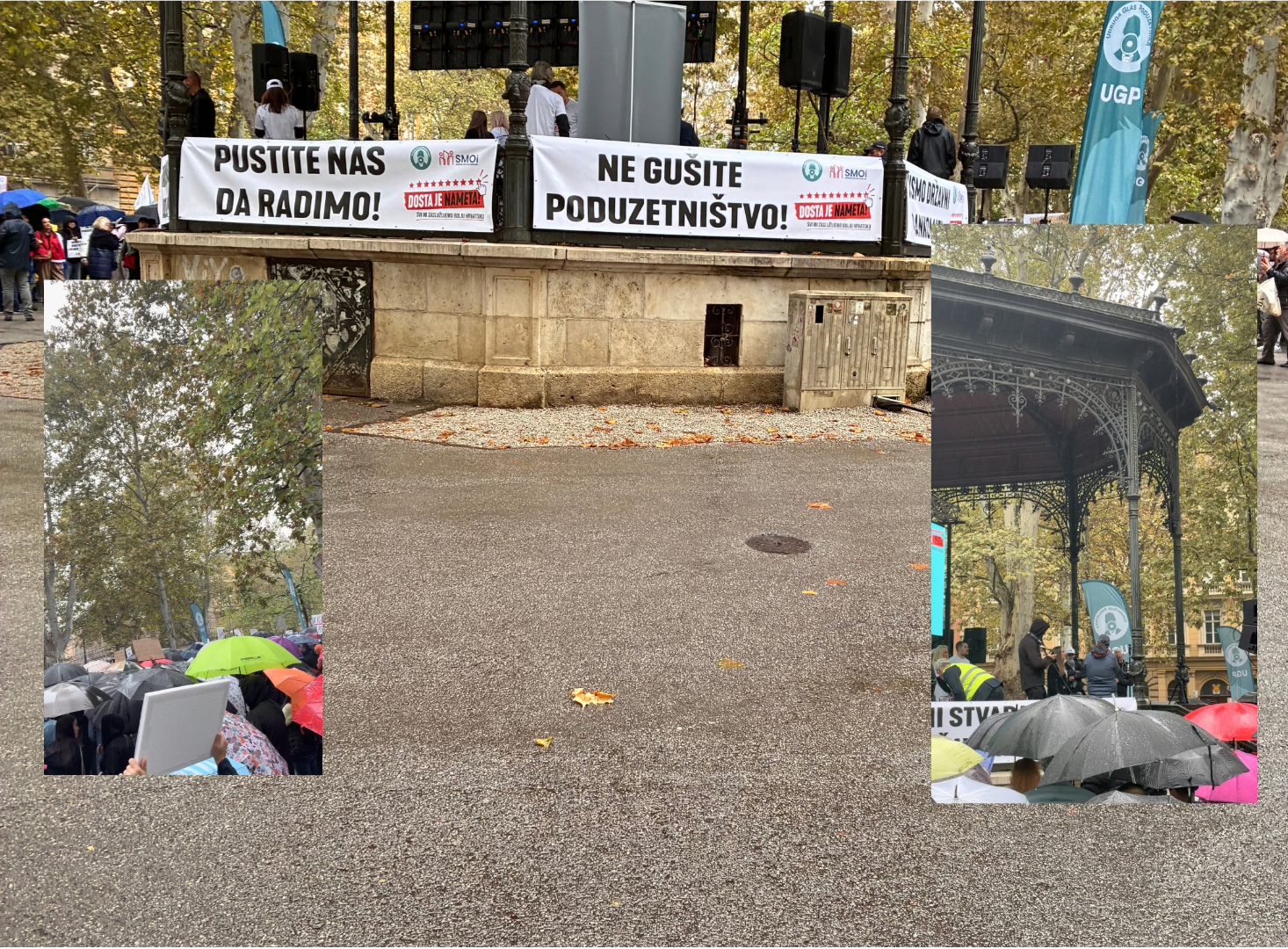
On Saturday, craftspeople, small business owners and family accommodation providers gathered at Zagreb’s Zrinjevac park. They are calling for lower tax and administrative burdens, more stable business rules and a stronger voice in regulations that directly determine how much it costs them to operate.
The protest was organised by the Voice of Entrepreneurs Association (Udruga Glas poduzetnika) and the Save Small Family Renters association (Udruga spasimo male iznajmljivače). Speakers warned about rising charges, mandatory membership fees, administrative burdens, inspection penalties and frequent changes to the rules.
But behind the political messages heard at the protest lies a question that can be examined through numbers: how much has the cost of running a small business in Croatia increased in recent years?
A flat-rate sole trader is usually not a “company”, but one person
Although the terms entrepreneur, employer and sole trader are often grouped together, the reality is somewhat different.
Croatia currently has more than 144,000 active crafts and sole-trader businesses, employing more than 268,000 people. More than 90 percent of Croatian crafts businesses have three employees or fewer.
In many cases, a business is effectively a single job. The owner is simultaneously the manager, salesperson, administrator, marketer, purchaser and the person actually providing the service or producing the goods.
In other cases, the business is run by partners, spouses or a small family team with one or two employees. Flat-rate sole traders are particularly numerous. By the end of 2025, there were around 101,000 of them. An increase in fixed monthly costs does not affect a self-employed sole trader in the same way it affects a large company. For a self-employed person, it directly reduces the amount of money available to live on.
Social security contributions rise almost every year
The clearest example of this continuous increase is mandatory social security contributions. A flat-rate sole trader whose business is their main occupation pays contributions based on a monthly assessment base set by the state each year.
In 2020, that base was approximately €464. In 2023, it stood at €546.87. It then rose to €624 in 2024, €719.20 in 2025 and €797.20 in 2026. Translated into the actual monthly cost of contributions, this amounts to approximately €169 per month in 2020, €200 in 2023, €228 in 2024, €263 in 2025 and €291 per month in 2026.
This means that between 2024 and 2026 alone, this fixed monthly cost for flat-rate sole traders increased by almost 28 percent. Compared with 2020, the increase is around 72 percent. For someone generating several thousand euros in monthly revenue, that difference may not initially appear dramatic. But revenue is not a salary. From that revenue, a sole trader must finance equipment, business tools, transport, accounting, marketing, utilities and other operating costs, and ultimately their own living expenses. Contributions must still be paid during a weak month.
Higher contributions do not necessarily mean a high future pension
What does a sole trader receive in return?
Flat-rate sole traders pay contributions on a prescribed assessment base that is significantly lower than the average Croatian salary. This also means that their future pension is calculated according to the relationship between their insured income base and the national average salary. In other words, a higher monthly contribution bill does not mean that a flat-rate sole trader is building up a proportionally high pension entitlement.
The structure of the system means that many years of insurance contributions paid on a relatively low assessment base also result in relatively low pension value points.
At the same time, the state encourages self-employment
This creates another paradox. For years, the Croatian state has financially encouraged unemployed people to start their own businesses. Self-employment grants remain one of the country’s official active labour market measures in 2026. Public money is therefore used to help a person open a business, purchase equipment and create their own job.
They then enter a system in which the mandatory contribution base changes almost every year and business rules can change significantly within just a few years. As speakers at the protest also stressed, the problem is not the existence of taxes and social contributions. Healthcare, pension and other public systems cannot function without them. The problem arises when someone who decides to become self-employed under one set of rules cannot reliably estimate what the same business will cost them two or three years later.
The flat-rate system expands, then becomes the target of new increases
Flat-rate taxation was introduced precisely as a simpler model for the smallest businesses.
Over the years, the threshold for flat-rate taxation has been increased, and in 2025 two new revenue brackets were introduced, covering annual receipts of €40,000 to €50,000 and €50,000 to €60,000.
This effectively allowed more small businesses to remain within the flat-rate tax system.
Just one year later, discussion began about substantially increasing their financial obligations.
For 2027, the government is proposing higher tax and contribution burdens for sole traders in the two highest brackets. According to government calculations, the total annual increase for those earning between €40,000 and €50,000 should amount to around €1,336, while those earning between €50,000 and €60,000 could face an increase of around €3,033.
The Croatian Chamber of Trades and Crafts, whose membership is mandatory for entrepreneurs and craftspeople, publicly warned that flat-rate sole traders are not a “tax haven”, but people who find their own clients, generate their own income and assume business risk without many of the protections that come with standard employment.
Higher costs also bring more administration
A new phase of fiscalisation and e-invoicing was introduced in 2026.
For a small business, this means adapting software, invoicing methods, classifications of goods and services, and internal business processes.
A large company can delegate such changes to its finance department, accountants and IT staff.
A flat-rate sole trader is very often one person.
Time spent studying tax instructions, fiscalisation rules, new forms and regulatory changes is not merely an administrative detail. It is time during which that person is not performing work they can charge for.
Sole traders are not the only ones facing changing rules
Small family accommodation providers have experienced a similar sense of instability in recent years.
Their position is particularly sensitive because Croatia faces serious problems with housing affordability, high property prices and very expensive long-term rents.
Part of the public therefore sees private short-term accommodation providers as one of the causes of the problem.
But this group is not homogeneous either.
Some owners operate dozens of apartments and function as professional investors, but more often they are people renting out one apartment, one floor of a family home, or several rooms during the tourist season.
In recent years, they have faced the introduction of property tax, higher ranges for flat-rate tourist tax per bed, a requirement to obtain co-owners’ consent for short-term rentals in residential buildings, and new rules governing the management of such properties.
Short-term rentals should be regulated, but a citizen who invested tens of thousands of euros several years ago under the rules that applied at the time can no longer automatically assume those rules will remain unchanged while they are still repaying a loan or recovering their investment.
That is precisely what representatives of small family accommodation providers warned about at Zrinjevac.
Hana Matić said that people had not come to the protest because they refused to pay taxes, but because they had invested over the years according to rules that are now being changed.
How many changes can a small business absorb?
More than 144,000 crafts and sole-trader businesses currently operate in Croatia. More than 90 percent of them have no more than three employees.
When the state changes a tax rule for a large company, the cost can be distributed throughout the organisation.
When it changes the rules for a person who is their own only employee, the entire cost lands on one person.
That person has to find the money for social contributions. They have to find the money for taxes. They have to learn a new invoicing system. They have to follow regulatory changes. They have to find clients. They have to perform the work. They have to collect payment.
And from whatever is left, they have to pay for their own life.
Unlike an employee who receives an agreed net salary, a flat-rate sole trader first has to generate the revenue from which their own income can exist at all.
They personally bear the risk of a month without clients, an unpaid invoice, illness, holidays and the loss of work.
The state, meanwhile, collects its payments according to fixed statutory deadlines.