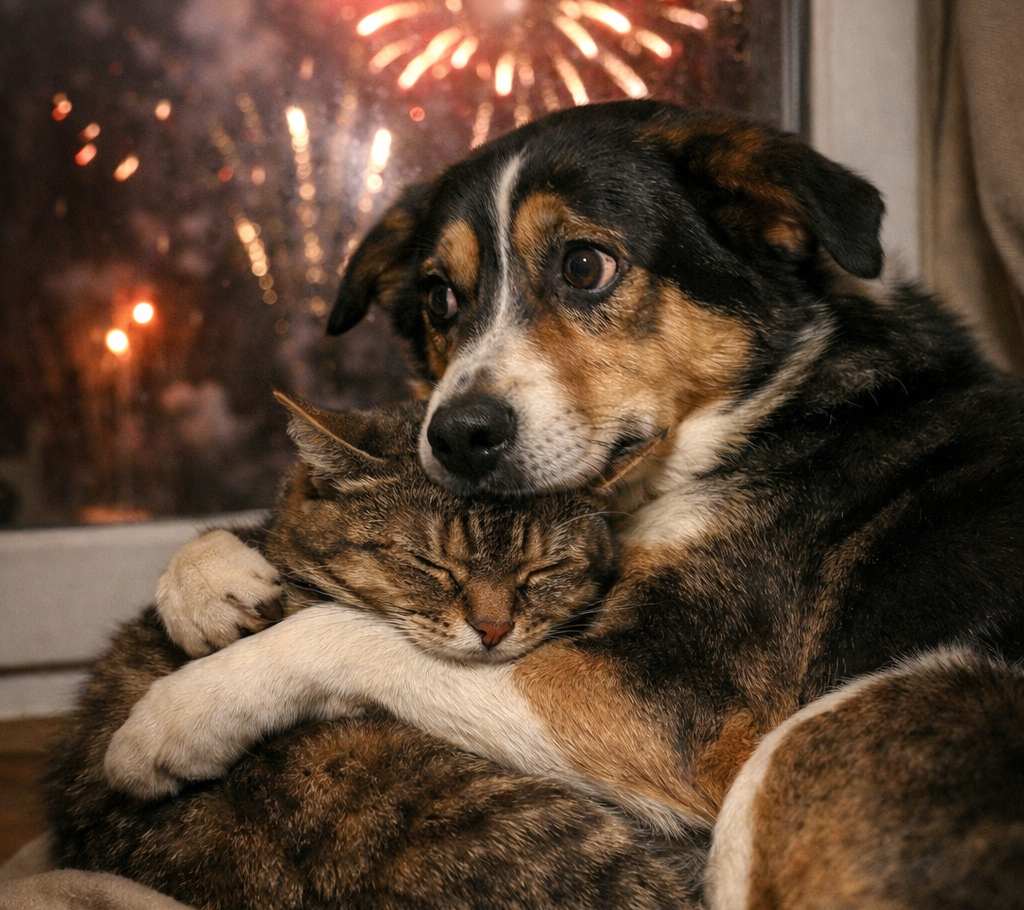
Veterinarians warn about serious consequences of fireworks noise on the psychophysical health of dogs and cats
While the sky above our cities is painted with thousands of colorful lights and the festive atmosphere reaches its peak with the sounds of firecrackers and rockets, a completely different story unfolds behind the closed doors of our homes. Millions of pets around the world experience their most terrifying moments of the year – moments filled with panic, fear, and unbearable noise that their sensitive hearing registers as a life-threatening danger.
Hearing That Perceives Too Much
Dogs hear on average four times better than humans, and their frequency range extends up to 65,000 hertz, while humans perceive sounds up to approximately 20,000 hertz. Cats are even more sensitive – their hearing reaches an incredible 85,000 hertz. What sounds like a loud firecracker to us is a deafening explosion that causes them pain.
“People often don’t understand that what is a celebration for us represents acoustic torture for our pets,” explains Dr. Maria Kovačević, a veterinarian with twenty years of experience. “The intensity of firecracker noise can reach up to 190 decibels, which is comparable to the noise of a jet engine. Imagine listening to such sound for hours, without the possibility of escape, without understanding what’s happening.”
Symptoms of Fear That Must Not Be Ignored
Veterinarians record a series of symptoms that pets show during fireworks: uncontrollable trembling, excessive barking or meowing, escape attempts, hiding in dark and narrow places, loss of bladder or bowel control, refusal of food and water, and even aggressive behavior towards owners.
However, what concerns experts even more are the long-term consequences. “We’re seeing an increasing number of cases of chronic stress, anxiety, and phobias that develop after repeated traumatic experiences with fireworks,” says Dr. Kovačević. “Some dogs develop such sensitivity that they begin to panic even at the sound of a storm or louder music.”
Physical Consequences Are Inevitable
Fear is not just a psychological phenomenon. Chronic stress caused by fireworks noise can lead to serious health problems: high blood pressure, cardiac arrhythmias, weakened immune system, digestive disorders, and worsening of existing health conditions.
Some cases are tragic. Veterinary clinics record injuries sustained during panicked escapes – from broken nails and scraped paws to more serious traumas. Every year, a certain number of animals lose their lives – either due to stress-induced heart attacks or because they escaped in panic and ended up in traffic accidents.
What Can Owners Do?
Experts offer a range of recommendations for reducing stress in pets:
Prepare a safe space in the quietest part of the apartment, away from windows. Use thick curtains and close all openings to reduce sound penetration. Play music or television at moderate volume to mask external sounds.
Stay with your animal – your calm presence can significantly reduce their stress. Don’t force physical contact if they don’t want it, but be available for comfort.
For animals with intense phobias, veterinarians can prescribe calming preparations or anxiolytics. There are also natural solutions such as pheromone diffusers, CBD oil, or herbal preparations, but definitely consult a veterinarian before use.
Specially designed “anxiety vests” that gently compress the body have proven effective in many dogs, working on a principle similar to swaddling a baby.
Social Responsibility and Regulation
More and more citizens and animal protection associations are calling for stricter regulation of fireworks. In some European cities, there are already bans or strict restrictions on the use of pyrotechnic devices, while others are introducing “quiet zones” or allowing only visual effects without a sound component.
“This isn’t about banning celebration, but about a responsible approach,” emphasizes Petra Novak from an animal protection association. “Technological solutions exist – silent fireworks, light projections, drone shows. We can celebrate without causing suffering to living beings that share space with us.”
This year’s New Year celebration will once again be a test of our empathy and civilizational maturity. While we wait for systemic solutions, it’s up to us as individuals to think about those who have no voice – our faithful friends who expect protection from us, not additional trauma.
If your pet shows signs of acute stress during fireworks – excessive whining, inability to calm down, signs of pain – immediately contact veterinary emergency services.