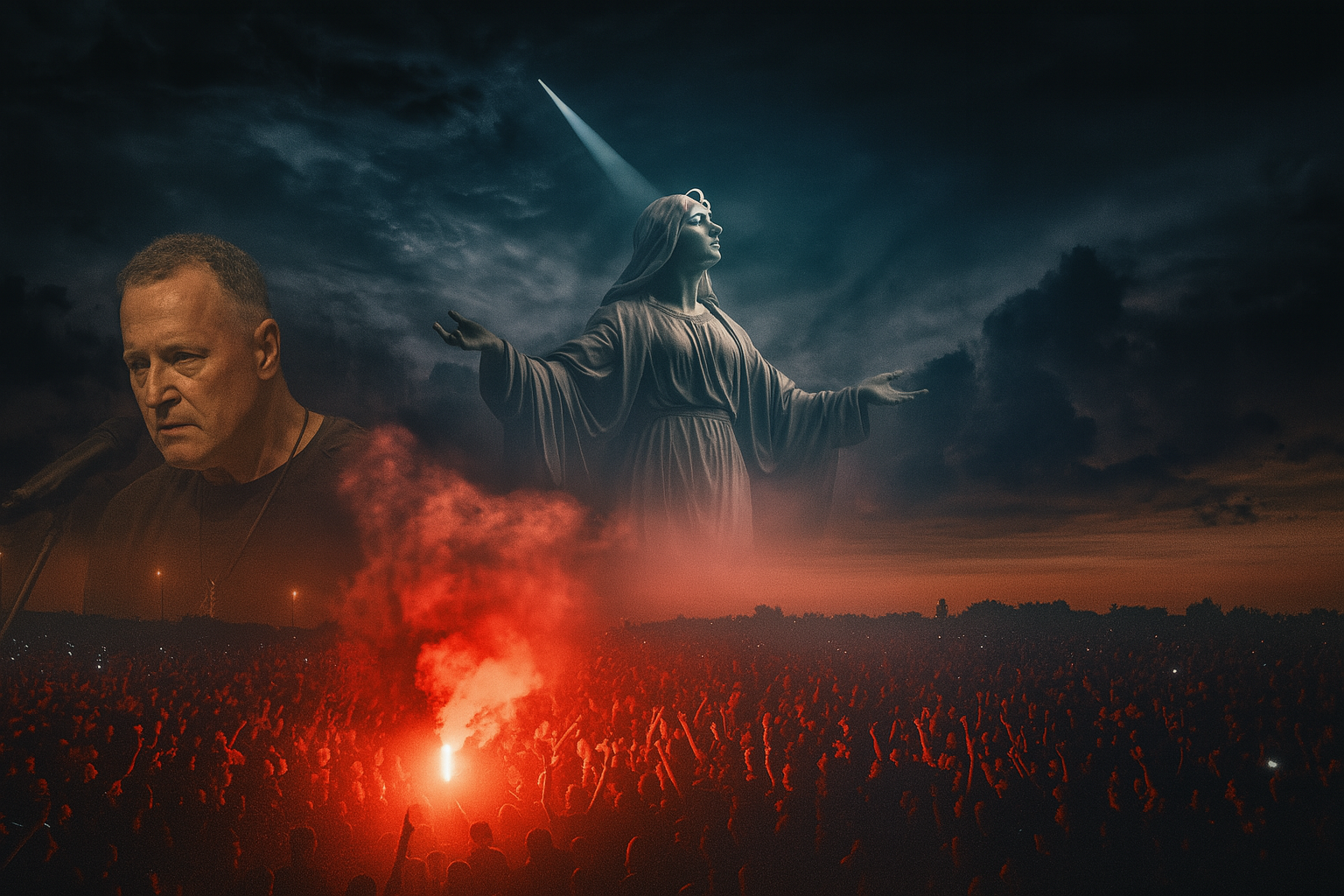
This weekend, more than half a million people gathered in Zagreb for a concert by singer Marko Perković Thompson. The event dominated media coverage: police interventions, alcohol overdoses, blocked bridges and avenues. On the surface, it was a concert, a spectacle, a mass gathering. But if we look more deeply, something entirely different emerges. Events like these are not just about music and entertainment—they’re reflections of collective consciousness, historical wounds still vibrating in the background, and unconscious impulses rising like currents beneath the surface.
A Land That Remembers
This region of the former Yugoslavia is no ordinary land. It is soil soaked in blood, emotions, memories of conflict and trauma passed down from generation to generation. Historical memory isn’t preserved only in books and archives—it lives in the landscape, in language, in gestures, and in the way people respond to stress, to belonging, to “the other.” Certain areas, including Zagreb, act as concentrated energetic nodes—what some call “consciousness hubs”—where history is compressed and vibrates more intensely.
Spatial Memory
Places like these, according to both ancient wisdom traditions and modern theories of energy, retain the imprints of the past as a kind of energetic memory. That memory doesn’t vanish—it lives in the space and occasionally erupts to the surface, especially in moments of tension or collective charge. When large groups of people simultaneously resonate with the same emotions—often unconsciously—the space responds. The ground itself becomes resonant, and we, thinking we are celebrating, may in fact be re-enacting an unresolved collective trauma.
As much as the wars left deep marks on individuals and society, those were also times when a sense of unity and belonging was most intensely felt—often through pain, fear, and resistance. Events like this may be an unconscious attempt by the collective to feel that lost sense of connection again, even if it comes through nostalgia and noise.
Mass and Vibration
When 500,000 people gathered in Zagreb, it wasn’t just the people that came together. It was their emotions, inherited patterns, suppressed traumas, identities, and exclusions. From the perspective of an energetic field, such an event acts as a massive amplifier. Everything in the “air”—collective narratives, old conflicts, unspoken grief—is activated and multiplied.
In this kind of atmosphere, individuals may feel playful, euphoric, but also unsettled, confused, without knowing why. This kind of emotional explosion on a collective level has a price—and it’s not always visible right away.
Zagreb as Resonator
Zagreb, as an energetic point, intensifies the situation. It is a city that historically and symbolically stands at the intersection of cultures—and conflicts. It’s where East meets West, North meets South, where religions, ideologies, languages, and customs collide. Its energetic field acts like a resonator—amplifying whatever occurs within it.
When thousands vibrate with low-frequency emotions like anger, fear, wounded pride, or unconscious ecstasy, Zagreb doesn’t just reflect it—it multiplies it. The city “remembers,” and that memory lives in its structure: in architecture, traffic systems, and in the restlessness that many feel but cannot explain.
A City of Anxiety or a City of Transformation?
This is why so many people feel inexplicably anxious in this city, why creative impulses quickly turn to frustration, and why collective emotions spread like wildfire. Here, inspiration and disillusionment live side by side.
Zagreb has the potential to be an epicenter of transformation—but only if we consciously work with the energy it holds. That requires awareness, daily practices of grounding, presence, and emotional hygiene. If the city as a whole becomes aware of its history, its wounds, and its inner strength, it can become a place of healing—not just a mirror of collective chaos.
The Moment of Choice
Moments like this—mass gatherings that appear to celebrate unity—are actually critical turning points. We’re faced with a question: will we repeat the old patterns of division, conflict, and unconsciousness, or will we pause and ask ourselves what these events truly reveal about who we are and the society we’re shaping?
The future is not prewritten. It depends on our willingness to look into the collective shadow and acknowledge what lives there. Every mass gathering holds power—the only question is where that power will be directed.
The Inner Call
If you felt discomfort, a subtle hum inside, or even physical pressure while witnessing these events—know that it’s not accidental. That’s your internal guidance system—your body and awareness recognizing this moment as a chance for change.
This is not a call to wake up with slogans and noise. This is a quiet awakening—one that begins in the body, moves through the mind, and lands in the heart.
What’s happening around us is not just politics or history—it’s vibration in real time. And our task is not just to observe—but to feel, to understand, and to choose differently. The choice doesn’t belong to the crowd. It belongs to each of us—in every moment we decide not to repeat the old story.
If we do that, the Balkans can become what it has always been in its potential: a place of deep insight, powerful transformation, and a new paradigm of consciousness.
Support & connection
If this article stirred something in you and you’re drawn to explore collective energy, awakening, and the making of a different reality— We invite you for a coffee. Not the rushed kind, but the kind where soul sits at the table.